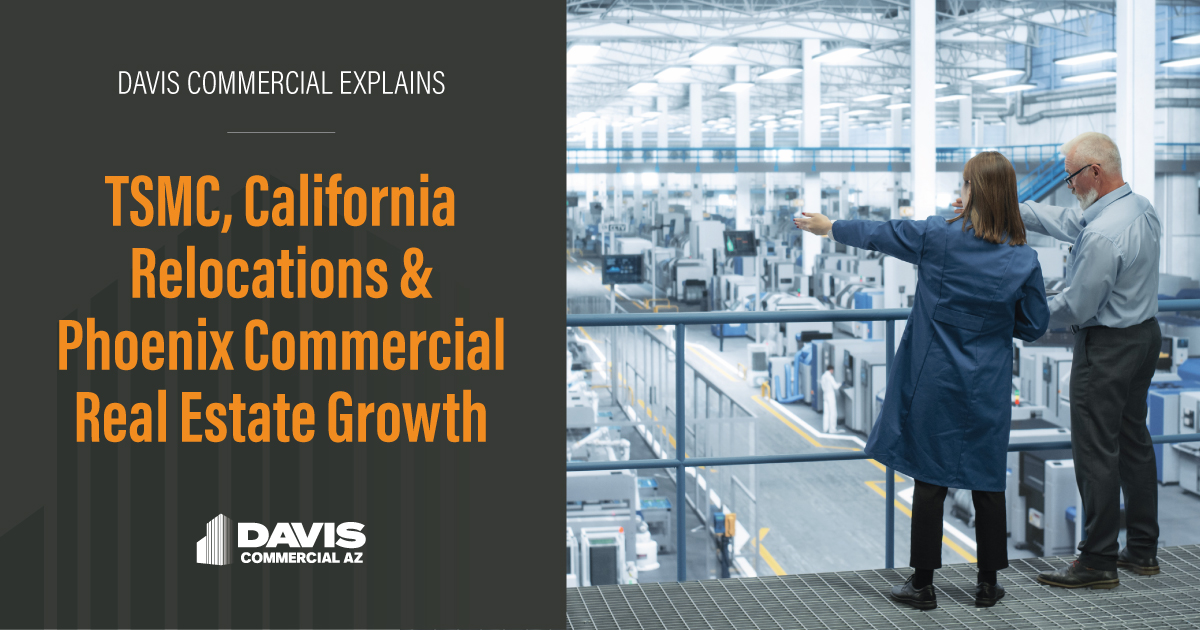
TSMC’s investment in North Phoenix represents one of the most significant economic developments in Arizona’s history, planned at $165 billion. As a global leader in semiconductor manufacturing, TSMC is bringing thousands of high-paying jobs and long-term economic stability to the region. Its presence reinforces Phoenix’s growing reputation as a center for advanced manufacturing and innovation, increasing confidence among investors, developers, and national companies evaluating the market.
The impact of TSMC extends well beyond its manufacturing facilities. Semiconductor production depends on a complex network of suppliers, logistics providers, engineering firms, and professional services. As these companies expand or relocate to support TSMC’s operations, demand continues to rise for industrial buildings, office space, and specialized commercial facilities. This ripple effect has become a major driver of activity throughout the Phoenix commercial real estate market expanding as far south as Tucson, AZ
At the same time, Phoenix remains a top destination for California companies seeking relocation or expansion. Rising operating costs, regulatory pressures, and limited growth opportunities have pushed many businesses to look beyond California. Phoenix offers a more business-friendly environment, lower occupancy costs, and access to a growing and skilled workforce, making it an attractive location for long-term corporate planning.
This migration has had a particularly strong influence on the Arizona industrial market. Manufacturing, distribution, and technology-related firms are absorbing industrial space at a steady pace, especially in areas with access to major transportation corridors and infrastructure. As demand increases, land values have risen and development activity has accelerated. Industrial real estate remains one of the strongest-performing sectors in the Phoenix market due to these sustained demand drivers.
Office real estate is also benefiting from these economic shifts. Companies supporting semiconductor manufacturing, along with businesses relocating from California, are expanding corporate offices and engineering operations throughout the metro area. Demand is strongest for modern office space that supports flexibility and efficiency. Well-located office submarkets tied to employment growth continue to show resilience as Phoenix attracts and educates skilled professionals.
Population growth further reinforces Phoenix’s commercial real estate fundamentals. As new jobs are created, more workers relocate to the area, increasing demand for housing and essential services. This growth supports retail centers, medical offices, and mixed-use developments, particularly near major employment hubs. These supporting commercial uses benefit from long-term population trends tied directly to job creation.
Infrastructure investment also strengthens the outlook for Phoenix commercial real estate. Large employers like TSMC require significant improvements to power systems, utilities, and transportation networks. These vital investments enhance surrounding submarkets, improve accessibility, and increase long-term property value. From an investment perspective, infrastructure expansion reduces risk and supports sustained growth across the Arizona industrial market and increases property values
The combination of TSMC’s expansion and California companies moving to Phoenix is redefining how the region is viewed nationally. Phoenix is no longer seen solely as a lower-cost alternative to coastal markets. It is increasingly recognized as a strategic and diverse location for advanced manufacturing, technology, aerospace, logistics, healthcare and bioscience, corporate operations, and hospitality.